How Shared Festival Routes Gain Meaning
Shared festival routes gain meaning through repeated public choices. Learn how movement, place and invitation turn a route into a ritual people can shape.
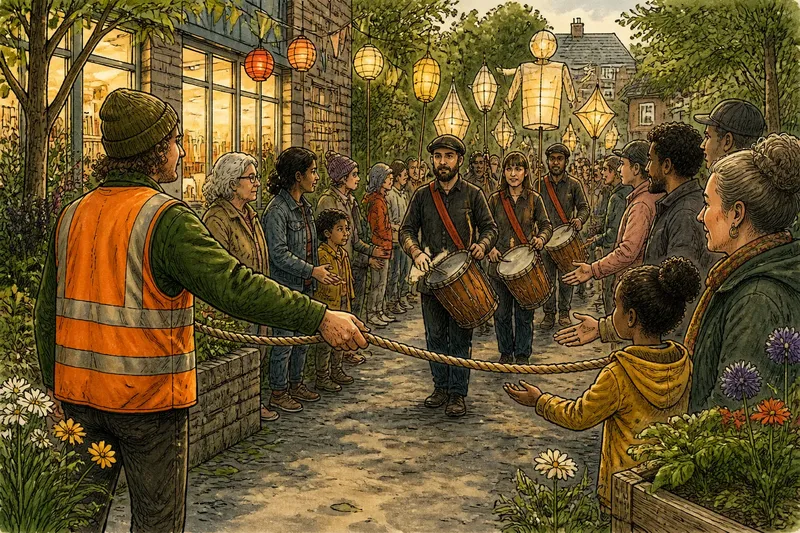
A steward lifts a rope across a narrow lane, then lowers it as drummers approach and the waiting crowd opens a passage. A shared festival route takes shape in that exchange: people gather, make room and move together, giving an ordinary street a temporary public purpose.
Shared festival routes do not acquire meaning simply because they are repeated or look ceremonial. Their meaning grows from what people do along the way, which places they pass and whether those affected can choose how to take part. A procession and a parade can overlap, but they tend to organise movement differently: one often centres on a shared act or destination, while the other often foregrounds display for an audience. Local usage varies, so the event’s own purpose matters more than the label.
Movement makes meaning
Start with the action people will share. They might carry lanterns to a meeting place, accompany musicians between neighbourhood venues or walk behind a figure made by local participants. Each action shapes the relationship between walkers, watchers and the place where they finish.
Think of the route as a line of chairs arranged for a conversation: the objects matter less than the encounter they make possible. A path between a library and a community garden might bring familiar neighbours together; a route across a civic boundary might make groups visible to one another. Neither outcome is automatic. Participants and residents give the route its meaning through their choices and responses.
Describe the shared action in ordinary language. Say who begins it, what participants do, where it ends and whether people may join or leave along the way. If those details are unclear, a grander route will not make the event easier to understand.
Place shapes the route
A route makes a claim on public space, even when that claim lasts only for the event. Choose places with the people who use them, and ask which sites should be included, avoided or approached differently. A familiar square may invite people to gather; a private entrance or quiet residential passage may make the same event feel intrusive.
Use these checks to connect the route to its setting:
- Neighbourhood connections: Check whether residents recognise and welcome the proposed meeting places. If they do, link those places; if they do not or raise concerns, ask what alternatives feel appropriate.
- Clear arrival and departure: Check whether newcomers can identify the start, finish and any joining points. If those points are easy to see, explain them in the event notice; if not, choose clearer places or add visible signs and stewards.
- Access along the way: Check the surface, crossings, places to pause and options for taking part without walking the whole route. If these support the people invited, describe them plainly; if they do not, adapt the path or provide a stationary way to participate.
- Consent at sensitive places: Check who is responsible for each site and whether affected neighbours have agreed to its use. If permission and welcome are clear, include it; if either is absent, reroute rather than treating visibility as consent.
- Shared authorship: Check whether people from every community the route touches have a say in its start, passage and finish. If they have helped shape it, explain how that agreement was reached; if they have not, pause the plan and invite them into the decision.
- Room for watching: Check whether people can observe without blocking a doorway or being pressed into the moving group. If there is space, mark a viewing area; if not, change the stopping point or route so spectators have a comfortable alternative.
Imagine a new neighbourhood festival with a library forecourt and a community garden as possible endpoints. Organisers ask residents to choose which meeting place should come first, check whether the path has a clear joining point and invite people to watch without walking. If residents prefer to begin at the garden and newcomers can recognise the joining point, the route can start there; if the path raises access or consent concerns, organisers can choose another connection before announcing it.
Repetition and change
Returning to the same streets can help people recognise where to gather, when movement begins and what happens at a familiar corner. Repetition also gives participants a chance to make a route their own. But familiarity is not the same as universal agreement: a custom that feels meaningful to one group may be unfamiliar or unwelcome to another.
Decide which elements need continuity and which can change. The starting place or shared act of carrying might remain, while music, objects, performers or words vary. Tell participants who may propose changes and how those suggestions will be considered. If the event draws on an established practice or passes through a place with a strong connection to others, speak with people directly connected to it before deciding what to repeat.
Keep practical requirements in view as well. Follow relevant venue, local authority and event-safety guidance, and seek qualified advice where permissions or access obligations are unclear. A route that changes in response to consent and access can still feel familiar; a route that never changes can still feel imposed.
Invitation along the way
People watching from the pavement are part of the event’s public setting, but they may not want to join. Say whether they can enter the procession, respond at a particular point or simply observe. Make joining optional, and explain how someone can leave without interrupting the group.
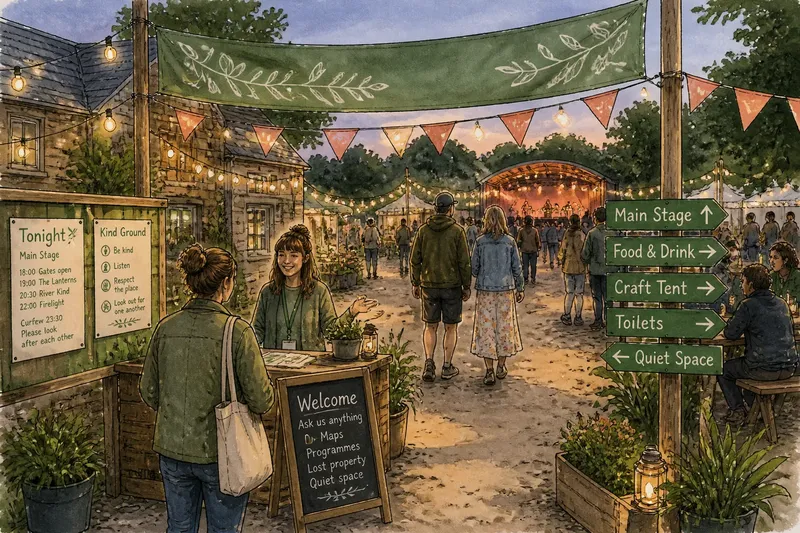
Put information where people need it: a sign at the starting point, a short notice shared beforehand and a steward who can answer questions. Mark joining and viewing places clearly. These cues should explain the invitation without turning a shared ritual into a sequence of rules to memorise.
Notice who can take part in ways other than walking. Someone might carry an object from a stationary place, greet the procession at its destination or watch from a quiet edge. If a person using a pushchair cannot see without blocking a doorway, move the viewing point; if a participant needs a place to pause, identify one before the event begins.
Questions about routes?
How does a procession differ from a parade?
Communities use the terms in different ways, and an event may combine shared movement with public display. Explain whether this gathering centres on a collective action, a spectacle for viewers or both, then use the language participants understand.
Should a festival route stay the same?
Keep elements that participants value and can use comfortably, but change the route when access, consent or the event’s purpose calls for it. A familiar starting place can remain while the path or stopping points shift.
How can newcomers tell if they may join?
Show the joining points before the event starts and make the invitation visible at the route itself. State that watching is welcome too, and explain how people can leave along the way.
What makes a route feel meaningful?
Look for the ways people use it: returning to a meeting place, greeting one another at a known point or asking to shape the next gathering. Treat these as local signs of connection, not evidence that everyone shares the same experience.
Review the shared route
After the event, ask participants, stewards, neighbours and first-time visitors where they felt welcome, where they hesitated and whether any part of the route seemed to belong to someone else. Specific observations are more useful than a general question about enjoyment. If people could not find the start, make it clearer; if a stopping place caused crowding, move it; if a place felt intrusive, ask those affected before considering it again.
Shared festival routes gain meaning when people can understand what is happening, choose how to participate and see their own relationship to the places along the way. Keep the route recognisable where that helps, and leave room for its users to reshape it. Before the next gathering, give one named participant or local group a clear way to suggest a change and make sure the organisers tell them what happens to that suggestion.