A Pocket Festival Souvenir, Chosen for the Story It Holds
Choose a pocket festival souvenir that recalls a vivid moment, fits your day and has a clear place at home, without collecting objects for their own sake.
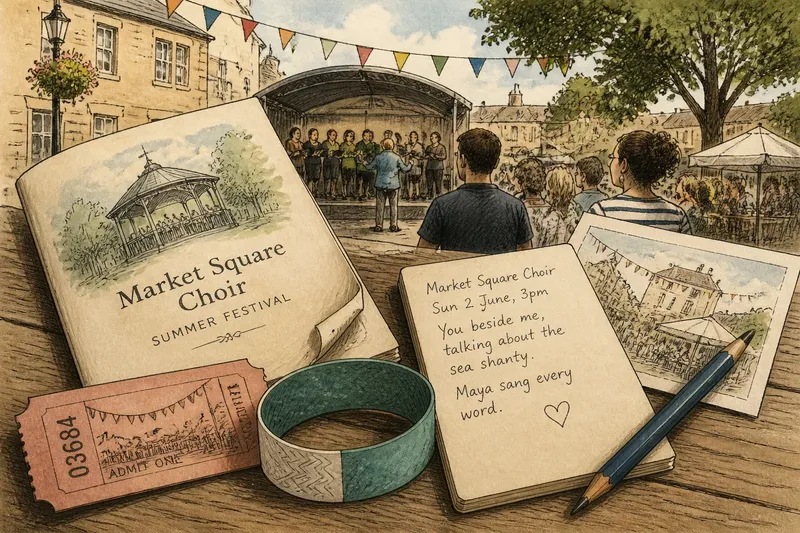
The last song fades, and you find a folded programme in your pocket beside a stamped ticket. A pocket festival souvenir can bring that particular evening back if you choose it for the moment it recalls, not simply because it carries the event’s name.
A keepsake is a cue for memory, not a trophy for having attended. It might be a paper wristband from the set where you met an old friend or a card from a craft stall you returned to. Choose one object with a clear personal connection; let its story, rather than its price or rarity, decide whether it comes home.
Meaningful souvenirs
A meaningful souvenir points to a moment you can describe. “I was there” is a broad connection; “this was the programme I held while my daughter sang along” gives you people, setting and feeling. The object need not be unusual. Its value lies in how readily it brings the memory to mind.
Before keeping or buying something, try explaining the connection in one sentence. If you can name what happened, who was there or what you noticed, the object has a useful anchor. If the only reason is its festival logo, it may still look appealing, but it is less likely to serve as a personal reminder.
Keep the object’s role modest. It does not need to represent the whole festival or everyone’s day. A souvenir works like a bookmark, helping you return to one page in a much longer story.
Choosing a pocket festival souvenir
Start with the moment, then consider what is already connected to it. Recall a striking exchange, a small act of kindness, a change in the music or a detail you noticed while waiting. Choose something that belongs to that memory rather than finding an object first and inventing a story afterwards.
Imagine you have just heard a local choir in a market square, and a singer gives you a spare programme. You keep it because its folded corner marks the song you discussed, then write the choir’s name and a brief reminder on the blank back. The result is a compact object with a recognisable cue, rather than an unannotated sheet that could belong to any visit.
For a purchase, look for a direct link between the item and the moment. A small print bought from the artist whose work you watched being made may carry that connection; a generic trinket chosen in a hurry may not. If the link is weak, leave the object behind and, where appropriate, make a personal note or photograph instead.
Use these checks before deciding:
- Check whether you can name the moment the object recalls. If you can, keep it in consideration; if you cannot, leave it behind or make a note of the moment instead.
- Check whether it fits in the pocket or small space you have set aside. If it does, carry it; if not, choose a smaller record or let it go.
- Check whether you have a place for it at home. If you do, bring it back; if not, take a note or photograph where appropriate rather than adding an unplanned object.
- Check whether it belongs to you and is suitable to take. If it does, keep considering it; if ownership or permission is unclear, ask a steward or maker, or leave it where it is.
- Check whether it is clean and safe to carry alongside paper or other belongings. If it is, pack it separately if needed; if it is damp, dirty or likely to stain, leave it behind or choose a written record.
- Check whether you still want it without the festival branding. If you do, it may have a personal purpose; if not, pass on it and keep the memory without an object.
A “no” does not mean you have chosen badly. It may simply mean this moment is better remembered without a souvenir.
Buying or saving
Saving an item you already have can make a more specific keepsake than buying something new. A ticket, clean wristband, programme with a note in the margin or postcard exchanged with a friend may already carry the right connection. A purchase makes sense when the maker, material or design adds something you genuinely want to remember.
Separate the souvenir from its record. The souvenir is the object with a personal link; the record is information that helps explain it. A small note can make an ordinary programme easier to place later, while a beautiful object may remain a mystery if you cannot remember why you chose it.
Do not remove signs, decorations, plants or objects belonging to a venue or another person. Avoid keeping anything borrowed, dirty, damaged or awkward to carry safely. If an item’s status is unclear, ask a steward or the maker, and follow the organiser’s instructions.
Keeping the story clear
Add a short note while the detail is fresh. Include one clue that matters: the friend beside you, the stall’s name, the rain arriving during a set or a phrase you want to remember. You do not need to record the whole day; one precise detail is easier to revisit than a rushed account of everything.
Use a pencil on sturdy card or slip a note beside an item you do not want to mark. Let damp paper dry flat before storing it. Keep fragile objects in a sleeve or small box, and separate anything that might stain or shed from photographs and paper keepsakes.
Choose a home for the object before you leave. A labelled envelope, a shallow keepsake box or a scrapbook page can keep it easy to find without turning it into clutter. Store the note with the object so the connection does not get lost.
Memories without objects
Some festival moments leave nothing to pocket: a crowd joining a refrain, a quiet conversation or a sudden change in the light. Write a line, sketch a simple shape or make a voice note after moving somewhere quieter. These are records rather than physical souvenirs, but they can still preserve the detail that matters.
If you take a photograph, choose one that recalls the moment instead of trying to document the whole event. Respect other people’s privacy and follow any photography rules set by performers or organisers. A short caption can make an image more useful to you than a folder of similar crowd shots.
Children may want to keep several things because choosing is part of the fun. Invite them to pick one item that tells a story, then let them draw or describe the rest. This leaves room for their memories without bringing every paper scrap or freebie home.
Keeping collections manageable
Decide on a small limit before browsing, such as one pocket-sized object for the visit. Treat it as a boundary, not a challenge to find the most impressive item. If one keepsake already carries the story, pass on extra badges, flyers and trinkets that repeat the same connection.
At home, revisit the object before adding it to a collection. If the story is still clear, put it in its chosen place. If you cannot remember why you brought it back, write down any clue you still have; if there is no clue and the item no longer matters to you, recycle or dispose of it appropriately. The aim is to keep the few things that help the memory return, not every trace of the day.
Questions about festival keepsakes?
Does a souvenir need to be bought at the festival?
No. An existing ticket, programme or note can hold a stronger personal connection than a new purchase. Choose for the story it recalls, not where it came from.
What if I cannot choose one moment?
Wait until the day is over and notice which scene you keep telling someone about. That repeated detail can point to the moment worth marking, without asking you to decide while browsing.
Can a photograph count as a keepsake?
Yes, if it brings back a specific moment and you can find it again later. Add a short caption or save it in a named album so it does not disappear among unrelated images.
Should I keep a free item?
Only if it has a clear connection to your experience and a place to go at home. Free does not mean useful; leave it behind if it adds no memory of its own.
Before heading home, hold the object and finish this sentence: “I kept this because…” If the answer names a real moment, the pocket festival souvenir has a clear purpose. If it does not, keep the note or memory instead; an empty pocket can be the right place for the next part of the day.